Exiled in England, it is toward the Imzad that I return. Every morning I try to reach the shore of the world of the living, making the ultimate effort to rise and to walk. Deprived of my family, of my friends and of my native land, my life has become a desert. The Imzad, which had saved me when I was lost in the true desert of the Sahara, today it is once again this same Imzad that saves me from the desert of my existence.
How many days have passed with the bitter taste of a deep distress. I wash my face without looking at myself in the mirror. I miss my husband, my son. Alone, facing the instant of this present moment, I hear it moan. It is the Imzad that stifles the howls of my soul. I emerge from the torpor that drowns me, I click on a playlist I have digitised from one of the audio CDs on my computer…. Today, still and always, I write to you « Imzad ».
I have known the desert. I discovered the Hoggar, its history, its nature, its men and its customs. And yet nothing had predisposed me to it. I was like everyone else, not hearing and not seeing all those things one neither sees nor hears, for the single reason that the moment to do so has not yet come. One thing is certain: it was given to me to learn a great deal about the desert.
At the beginning of the last century, the poet Khouya Aknar ben Joubbine had declaimed, in a poem entitled «Tin Aylanagh» which is sung to this day by the poets of the Ahaggar to the air of the Imzad:
« Yalla ila nagh, yalla ila nagh, yalla ila nagh
To God we belong, to God we belong, to God we belong.
Andihad, dat'amoud, iwt imzad
Yesterday at dawn, the imzad played
Immaghane, dagh ghassane yerna hiragh
It pierced my bones, going beyond my thoughts
Erna iwillane attouksi ijoujabe
More ardent than all the summers of the world
Ihak, yeghlayénne irakkab tisswad
I dream of being among those who are gathered around the imzad »
In singing this oral poetry, the Imzad has been the vessel bearing the warrior epic and love, close to the women who play the imzad, offering the world a chivalrous image of the Sahara. Despite the Punic, Roman, Vandal and Byzantine invasions, their language does not seem to have been altered by foreign influences. Far from being merely a musical instrument, the Imzad represents at once the past and the dream of the Touaregs. It tells of a culture, that of love and of the respect for human values; it teaches us a philosophy of life born in a space shaped by a harsh nature, in a land of civilisation and of human creations.
Over time, with modernity and the abandonment of traditional cultural activities, the transmission of this art was on the verge of vanishing. It is this realisation that led me, through the Association « Save the Imzad », to found a school for training in the imzad and to undertake work for the safeguarding of these musical traditions, threatened with disappearance. I had chosen to approach the history and the lived experience of the imzad through the organisation of international colloquia, through publications and videos and audio CDs that I produced entirely as a volunteer, thanks to the Association. In my own way, I have tried to illustrate the idea that remembrance is the only way to slow the race of time, without, for all that, claiming to halt it.
In the book Imzad I gathered together all the photographs collected throughout my life. I tried to create this work by presenting it as an invitation to a journey to understand the Touareg soul. This soul, joined to a nature of impressive majesty and of an ineffable beauty, has been able to make its values prevail through a cultural expression uniting grandeur and simplicity. I had to present the finest way of contributing to making known, understood, loved and respected a culture borne by a musical instrument as rudimentary as the imzad.
To catch up with life through photography, to fix the immaterial, to capture the attitudes of those minute things that pass like a fleeting shadow, like a glance, such was my aim when I undertook the making of this work. I applied myself to writing and to fixing the image, so as not to lose the instants, the snapshots of scenes, in order to know better and to make better known an ancestral art that man has modelled in his own image.
Much research and many studies have been conducted to explain the historical dynamic of the imzad, which we know to have undergone a brutal decline of a kind that gravely affected the collective memory of the Touareg. It is a happy thing that in these recent years it has been able to regain its rightful standing.
By what artifice of providence could a thousand-year-old intangible heritage as rich as that evolving around the imzad — this monochord fiddle fashioned from natural elements and handled with skill by women who master its power — have survived?
The photographic documents I produced over these last three decades, as well as the field surveys carried out, are my testimony to bring back to life this cultural richness that I wished at all costs to make known, in order to preserve and to enhance it, in the interest of humanity, of the Algerian nation and of the Touareg people.
The imzad had to be saved. A great step was taken in this direction by UNESCO when it inscribed it on the list of the intangible heritage of humanity on 4 December 2013.
One of the important facets that forms an integral part of this heritage remains the poetry that accompanies the imzad. This poetry is profound but also a bearer of information, just as much as the engravings or rock paintings of prehistory. Thanks to it, the accounts of daily life that the imzad has sung across the centuries allow us to approach the sociological and historical study of the region with precise data. It was given to me to catalogue nearly three hundred sung poems, which I hope to have published not in my name but in the name of a world cultural heritage of humanity.
The imzad was thus making its entrance into the history of the world's cultures; no one will be able to ignore it any longer, and it will no longer sink into the mysteries and the depths of oblivion. This resurgence we owe to men and women who worked at it tirelessly, inflicting a happy refutation upon these words of the great poet Shams of Tabriz:
« I gazed upon the mysteries of the worlds above and below
I believed that all men saw the same thing
I came at last to understand that they did not see. »
For, in the far reaches of the desert, men were able to see. If a thought or a memory crosses our mind, at night, we are quick to forget it if we do not note it down or if we do not give it material form…
Are there thoughts or memories that are important in one second and no longer so the next? Unless oblivion be a way of life, everything can be caught up again.
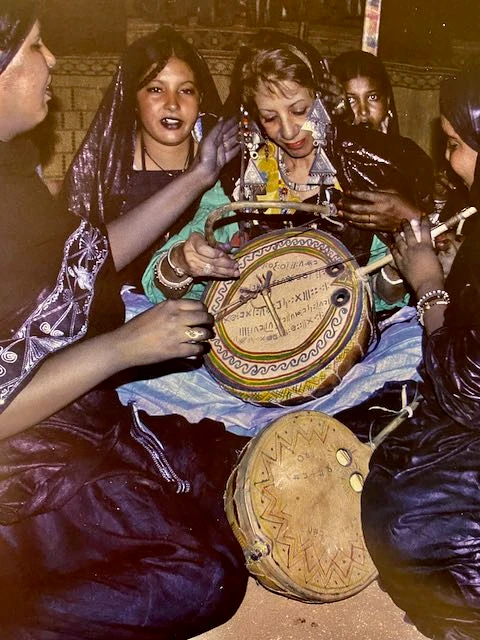
One need only be attentive to understand the story of the imzad. My reason for being has been to deliver a few living aspects, as a contribution to the effort of all those who have always refused to capitulate before oblivion. This new digital era offers us the opportunity to make the IMZAD live eternally.
To work for the preservation and the safeguarding of this thousand-year-old culture, by sharing it and making it known to the whole world, has always been my ultimate goal.
« There are weak ones who are strong and strong ones who can be weak; certainty is never acquired », the ancient Touareg sages teach us.
To discover it, click on this link, and all together, let us sing the imzad !